|
Getting your Trinity Audio player ready... |
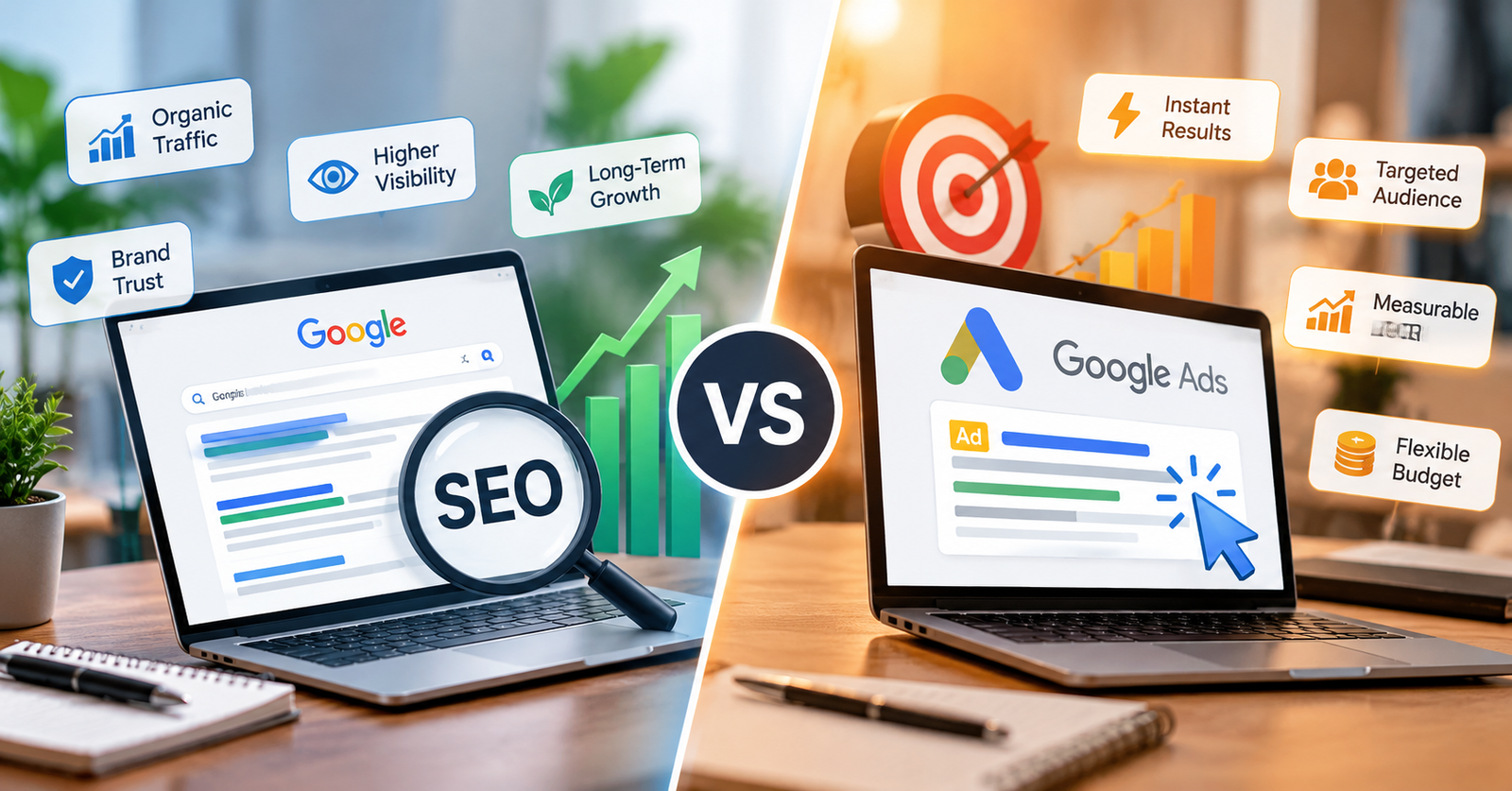
Choosing between SEO vs PPC is one of the most important decisions businesses make when developing a digital marketing strategy. Both approaches help businesses attract potential customers through online search, but they work differently, require different investments, and deliver results on different timelines.
SEO is generally better for building long-term organic visibility, while PPC is better for generating immediate paid traffic and testing marketing opportunities. The right choice depends on your business goals, available budget, competition, customer journey, and how quickly you need results.
For example, a new eCommerce store launching a seasonal collection may benefit from PPC campaigns that generate immediate product visibility. Meanwhile, a service-based business that wants consistent leads over several years may benefit from investing in SEO. Many businesses can achieve stronger overall results by combining both strategies.
In this guide, we will explain the differences between SEO and PPC, compare their costs and benefits, explore their return on investment, and help you decide which strategy is right for your business in 2026.
What Is SEO in Digital Marketing?
Search Engine Optimization (SEO) is the process of improving a website’s visibility in organic search engine results to attract relevant visitors without paying for every click.
SEO focuses on helping search engines understand your website and making your content useful to people searching for information, products, or services.
Suppose you run a digital marketing agency and want to attract businesses looking for SEO services. You could optimize your website for relevant searches such as “SEO services for small businesses” or “affordable SEO agency.” When your pages earn prominent organic positions, potential clients can discover your business through search.
SEO involves several activities.
1. On-Page SEO
On-page SEO improves individual website pages to make them more relevant and useful for searchers.
Common activities include:
- Researching relevant keywords and search intent.
- Writing descriptive title tags and meta descriptions.
- Structuring content with clear headings.
- Optimizing product and service descriptions.
- Improving internal linking.
- Adding descriptive image alt text.
- Creating helpful, original content.
For example, an eCommerce website selling winter clothing could create a detailed category page for winter jackets for women. A well-optimized page can help search engines understand its products and help shoppers find relevant options.
2. Technical SEO
Technical SEO focuses on the technical elements that affect how search engines discover, crawl, render, and index website content.
Important activities include:
- Improving website loading performance.
- Ensuring mobile usability.
- Fixing broken internal links.
- Managing XML sitemaps.
- Resolving unwanted indexing issues.
- Implementing appropriate canonical tags.
- Using structured data where relevant.
- Improving website architecture.
Technical SEO is especially important for large eCommerce websites with hundreds or thousands of product and category pages.
3. Off-Page SEO
Off-page SEO includes activities that help establish a website’s reputation and authority beyond its own pages.
These activities may include earning relevant backlinks, digital PR, brand mentions, and building relationships with reputable websites.
Quality matters more than simply accumulating links. Buying large quantities of low-quality backlinks can create risks rather than sustainable benefits.
4. Content Marketing
Content marketing supports SEO by answering questions your potential customers are already asking.
A business might publish guides, comparison articles, tutorials, case studies, and frequently asked questions to attract visitors at different stages of the buying journey.
For instance, a company selling project management software could publish articles about team productivity, project planning, and software comparisons. Helpful content can attract people before they are ready to purchase.
What are the main benefits of SEO?
The biggest advantage of SEO is its potential to generate relevant traffic over an extended period without paying an advertising platform for every visit.
Other benefits include:
- Long-term visibility: Useful pages can continue attracting visitors after publication.
- Brand credibility: Organic visibility can help people discover and become familiar with your business.
- Compounding returns: A strong library of relevant content can generate traffic from multiple searches.
- Lower marginal traffic costs: Additional organic visits do not incur a direct advertising charge per click.
- Customer education: Informative content can answer questions and support purchasing decisions.
However, SEO is not free. Businesses may invest in strategy, content creation, technical improvements, outreach, and professional services. Rankings also fluctuate, and results are never guaranteed.
What Is PPC Advertising?
Pay-Per-Click (PPC) advertising is a digital advertising model in which advertisers generally pay when someone clicks on an ad. It allows businesses to purchase visibility on advertising platforms rather than relying entirely on organic rankings.
Google Ads is a major PPC platform, while Microsoft Advertising and various social advertising platforms offer additional paid acquisition opportunities.
PPC campaigns can help businesses reach relevant audiences based on search queries, locations, interests, demographics, shopping behavior, and other targeting signals available on each platform.
For example, a company offering emergency plumbing services could use Google Search Ads to reach people searching for plumbing assistance in its service area.
1. Search Advertising
Search ads can appear when users search for specific products or services.
Businesses can target commercial keywords such as “buy running shoes online” or “digital marketing agency near me.”
Search advertising is particularly useful when people already have an identifiable need and are actively looking for a solution.
2. Shopping and E-commerce Advertising
ECommerce businesses can use shopping ads and eligible product-focused campaigns to showcase product images, prices, and other information.
These campaigns can help shoppers discover products while comparing available options.
Results depend on factors such as product demand, feed quality, bidding strategy, pricing, landing-page experience, and competition.
3. Display and Remarketing Campaigns
Display advertising can introduce products or services to audiences across participating websites and apps.
Remarketing can help reconnect with eligible previous website visitors or customers, subject to platform policies, privacy requirements, and available audience data.
These campaigns may support brand awareness and encourage people to return when they are ready to purchase.
4. Social Media Advertising
Platforms such as Meta and Pinterest offer paid advertising opportunities that can support discovery, engagement, lead generation, and sales.
Unlike search advertising, which often reaches people expressing an existing need, social advertising can introduce products to people who may not yet be actively searching for them.
What are the main benefits of PPC?
PPC provides businesses with several advantages:
- Fast visibility: Eligible campaigns can begin generating impressions and clicks soon after launch.
- Budget control: Advertisers can set campaign budgets and manage spending.
- Audience targeting: Campaigns can focus on selected locations, search terms, and other available audience signals.
- Measurable performance: Conversion tracking can help evaluate leads, purchases, and revenue.
- Rapid experimentation: Businesses can test ad messages, landing pages, and offers.
- Scalability: Successful campaigns may be expanded when profitability and demand support additional spending.
PPC also has limitations. Competitive clicks can be expensive, advertising platforms can change, and traffic usually declines when campaigns stop. Paid traffic does not automatically produce profitable sales.
SEO vs PPC: What Are the Main Differences?
The main difference between SEO and PPC is how businesses obtain search visibility: SEO earns organic visibility, while PPC purchases advertising placements.
Both approaches can attract relevant customers, but their costs, timelines, measurement methods, and long-term characteristics differ.
| Comparison factor | SEO | PPC |
|---|---|---|
| Traffic source | Organic search results | Paid advertising placements |
| Time to initial visibility | Often takes months to build meaningful results | Can begin soon after campaign approval |
| Payment model | Investment in optimization, content, and expertise | Advertising spend plus management and creative costs |
| Long-term potential | Can continue producing traffic after work is completed | Traffic generally depends on continued campaign funding |
| Budget flexibility | Work can be prioritized according to available resources | Daily and campaign budgets can be adjusted |
| Audience targeting | Primarily driven by relevance and search intent | Offers campaign-specific targeting options |
| Testing speed | SEO changes may take time to evaluate | Many ad variations can be tested relatively quickly |
| Main measurement | Organic clicks, rankings, leads, and conversions | Impressions, clicks, conversions, acquisition costs, and revenue |
| Best use cases | Sustainable visibility and long-term demand capture | Immediate promotion and faster acquisition experiments |
Neither channel is automatically more profitable. The outcome depends on how well the strategy matches customer demand, business economics, and conversion opportunities.
SEO vs PPC: Which Strategy Is More Cost-Effective?
SEO may become more cost-effective over time when optimized pages generate sustained traffic, while PPC can be more cost-effective when paid campaigns consistently acquire customers at a profitable cost.
The best comparison considers the total cost of acquiring a customer rather than focusing only on the cost of a click.
Understanding SEO Costs
SEO expenses can include content production, technical development, keyword research, SEO tools, digital PR, and specialist fees.
Consider a business that invests ₹30,000 per month in SEO. Its costs might initially support technical improvements, content creation, and optimization. Results may take time to develop, but successful pages can continue attracting relevant visitors.
The business should evaluate whether the resulting organic traffic generates qualified leads, purchases, and revenue.
Understanding PPC Costs
PPC expenses generally include advertising spend and may also include agency management, creative production, landing-page development, and tracking implementation.
Suppose a business spends ₹30,000 on Google Ads and receives 600 clicks.
Its average cost per click would be:
₹30,000 ÷ 600 = ₹50 per click.
If 18 of those visitors become qualified leads, the advertising cost per lead would be:
₹30,000 ÷ 18 = approximately ₹1,667 per lead.
This calculation excludes additional management and operating costs. It also assumes the leads are valid and attributable to the campaign.
How should businesses compare the costs?
Evaluate both channels using metrics that reflect business outcomes.
- Cost per lead (CPL): Total acquisition cost divided by the number of qualified leads.
- Customer acquisition cost (CAC): Total relevant sales and marketing costs divided by the number of new customers acquired.
- Conversion rate: The percentage of eligible visitors who complete a desired action.
- Revenue generated: The revenue attributable to the channel, measured consistently.
- Profit contribution: Revenue minus relevant costs, including product or service delivery expenses.
For SEO, use a consistent measurement period and account for the time required to build visibility. For PPC, include advertising spend and relevant operational costs.
A channel with cheaper traffic is not necessarily better. A higher-cost channel may generate customers with stronger conversion rates, larger order values, or greater lifetime value.
SEO vs PPC: Which One Delivers Faster Results?
PPC generally delivers faster visibility, whereas SEO usually requires sustained effort before a website achieves meaningful organic growth.
PPC is useful when a business needs to promote a new product, fill a limited number of appointments, or generate leads for an upcoming campaign. Once the campaign is approved and eligible to serve, it can start reaching potential customers.
However, immediate visibility does not guarantee immediate sales. Campaigns still need relevant targeting, persuasive ads, an effective landing page, and a suitable offer.
SEO follows a different timeline. Search engines need to discover and index content, evaluate its relevance, and determine where it belongs in search results. Competition, website condition, content quality, and search demand influence how quickly progress occurs.
A new website targeting competitive keywords may require considerable time and effort before it generates substantial organic traffic.
Which strategy should you choose when time matters?
Choose PPC when you need to test demand or generate traffic quickly and have the budget to support paid acquisition.
Prioritize SEO when your objective is to build an organic traffic source that can support your business over the long term.
If your business needs both immediate leads and future organic growth, running PPC while building SEO can help balance short-term and long-term objectives.
When Should a Business Choose SEO?
SEO is particularly valuable for businesses that want sustainable organic traffic, stronger search visibility, and a long-term source of qualified leads or sales.
Consider SEO when your business matches one or more of these situations.
You Want Long-Term Growth
If your business plans to operate in a market for years, investing in useful content, website structure, and technical performance can build an organic acquisition channel.
A well-maintained article may continue answering customer questions long after it is published, although its visibility can change over time.
Your Customers Research Before Buying
Some purchases require research, comparisons, and trust.
Businesses offering professional services, software, education, home improvement, or complex products can use SEO content to answer customer questions before a purchase.
Guides, case studies, service pages, and comparison articles can help potential customers understand their options.
You Want to Reduce Dependence on Paid Traffic
A business that relies entirely on advertising may experience difficulties when costs rise or its budget decreases.
Developing organic visibility can diversify acquisition sources. SEO does not eliminate paid advertising costs, but it can reduce reliance on advertising as the only source of website traffic.
You Have Valuable Knowledge to Share
If your business has expertise that can solve customer problems, SEO can help turn that knowledge into useful resources.
Original research, detailed explanations, practical examples, and expert commentary can differentiate your content from generic articles.
When Should a Business Choose PPC?
PPC is a strong option when a business needs faster visibility, wants to test market demand, or can acquire customers profitably through paid campaigns.
It is especially useful in the following situations.
You Are Launching a New Product
A new product may have limited organic visibility because its website pages have not yet built a search presence.
Paid campaigns can introduce the product to relevant audiences while the business develops organic content and improves product pages.
You Need Leads Within a Specific Period
Service businesses may need to generate inquiries for a promotion, event, or sales target.
Search campaigns can reach users who are actively looking for relevant services, provided the campaign has appropriate targeting, budget, and landing pages.
You Want to Test Offers Quickly
PPC allows marketers to compare different headlines, value propositions, audiences, and landing pages.
For example, a marketing agency could test whether customers respond better to a free website audit or a paid consultation offer. The findings may inform both paid campaigns and website messaging.
You Sell Products Online
ECommerce brands can use paid shopping and search campaigns to promote products based on customer demand, product availability, and commercial objectives.
Before increasing advertising spend, businesses should understand their gross margins, return rates, fulfillment costs, conversion rates, and acceptable acquisition costs.
Can SEO and PPC Work Together?
Yes. SEO and PPC can complement each other by combining immediate paid visibility with long-term organic growth.
Instead of treating SEO and PPC as competing channels, businesses can use them to support different stages of customer acquisition.
Here are five practical ways to integrate them.
1. Use PPC to Identify Valuable Keywords
Paid search campaigns can provide information about search queries that generate qualified leads or purchases.
Review actual search terms, conversion rates, lead quality, and revenue rather than choosing keywords based on click volume alone.
Use these insights to inform SEO priorities, landing-page improvements, and content planning.
2. Build Organic Content Around Proven Customer Needs
If paid campaigns reveal strong demand for a particular service, develop helpful organic content that addresses related questions.
For example, a company generating leads through ads for technical SEO services could publish guides about website audits, indexing problems, site speed, and technical SEO costs.
This approach connects paid campaign insights with longer-term content development.
3. Use SEO Insights to Improve Paid Campaigns
SEO research can reveal customer language, important questions, and the topics that influence purchasing decisions.
These insights can inform ad messaging, landing-page content, and campaign structure.
A page that explains pricing, delivery timelines, and service inclusions clearly may help both organic visitors and paid traffic.
4. Coordinate Landing Pages and Conversion Tracking
Both channels benefit from clear landing pages that match user intent.
Ensure that conversion tracking measures meaningful outcomes such as qualified inquiries, completed purchases, or booked consultations. Avoid treating every click or low-value interaction as a business success.
For eCommerce businesses, properly configured analytics and advertising tags can improve visibility into campaign performance, subject to applicable consent and privacy requirements.
5. Measure the Combined Customer Journey
Customers may discover a business through an organic article, return through a paid advertisement, and eventually convert through a direct visit.
Use consistent attribution settings and compare channel-level performance with overall business results.
Attribution models provide useful perspectives, but they do not perfectly establish what would have happened without a particular marketing touchpoint.
An integrated approach helps businesses make better budget decisions without assuming that each channel operates independently.
SEO vs PPC for Small Businesses: Which Is Better?
For small businesses, SEO is often a strong long-term investment, while PPC can be useful when immediate leads or sales justify the cost. The best starting point depends on cash flow, urgency, and customer acquisition economics.
A local service provider with a limited budget may begin by improving its website, service pages, local search presence, and customer information.
A business that needs leads quickly could also run a tightly targeted paid search campaign focused on its most profitable services and service areas.
For small eCommerce brands, PPC may help validate product demand, while SEO improves category pages, product descriptions, and buying guides.
A practical approach is to prioritize the channel that addresses the most urgent business problem while establishing a plan for sustainable growth.
Avoid spreading a limited budget across too many campaigns or SEO activities without identifying which opportunities have the greatest commercial value.
SEO vs PPC for ECommerce Businesses
ECommerce businesses can benefit from combining SEO for product discovery and informational searches with PPC for targeted promotions, product advertising, and faster demand capture.
SEO activities may include optimizing category pages, improving product descriptions, creating buying guides, strengthening internal links, and resolving technical issues that affect product discovery.
For example, a clothing store could build organic visibility through category pages targeting winter coats for women and articles explaining how to choose outerwear for different climates.
PPC can complement these efforts by promoting products with strong demand, competitive pricing, suitable margins, and reliable inventory.
Before scaling advertising, calculate the break-even return on ad spend (ROAS).
If a product generates ₹2,000 in revenue but only ₹600 remains after product cost and other variable expenses, spending ₹700 to generate that sale would create a negative contribution before additional fixed costs.
The exact acceptable ROAS depends on margins, operating expenses, repeat purchases, and customer lifetime value.
SEO and PPC should therefore be measured against profitability rather than traffic or revenue alone.
SEO vs PPC for Local Businesses
Local businesses can use SEO to build ongoing visibility in relevant local searches and PPC to reach potential customers who need a service quickly.
SEO priorities include accurate business information, useful location and service pages, a well-maintained Google Business Profile when eligible, relevant reviews, and consistent customer information across appropriate directories.
For example, a dentist in Ahmedabad could create helpful service pages and maintain accurate local business details to improve discovery by nearby patients.
PPC can help promote specific services to users within a suitable geographic area.
However, businesses should consider the value of each lead, service capacity, location targeting, and conversion quality before increasing campaign budgets.
The strongest strategy depends on the business model. A restaurant, an emergency repair company, and a professional consultancy may require different balances of organic and paid acquisition.
How Does AI Search Visibility Affect SEO and PPC in 2026?
AI search visibility means making your business and content easier for AI-powered search experiences and answer engines to discover, understand, evaluate, and potentially reference.
Search experiences increasingly include generated answers, conversational interfaces, and summaries that may respond to questions without requiring users to open several websites.
For businesses, this creates an opportunity to produce content that clearly answers customer questions and demonstrates genuine expertise.
However, AI search visibility is not a separate shortcut that guarantees inclusion in generated answers. Different platforms use different systems, and appearing in an AI answer cannot be guaranteed.
How Can SEO Improve AI Visibility?
Focus on making your content useful, understandable, and trustworthy.
1. Answer the main question immediately.
Begin important sections with a direct response before explaining the details.
For example:
Question: Is SEO better than PPC?
Answer: SEO is generally better for building long-term organic visibility, while PPC is better for obtaining faster paid visibility. Businesses should choose based on their objectives, budget, and customer acquisition economics.
This format makes the information easy for readers to understand and straightforward for answer systems to interpret.
2. Use descriptive, question-based headings.
Organize content around questions customers genuinely ask, such as:
- What is the difference between SEO and PPC?
- How much does SEO cost compared with PPC?
- Which strategy generates leads faster?
- Can SEO and PPC work together?
- How should businesses measure ROI?
Each section should provide a complete answer rather than merely repeating the keyword.
3. Include original insights and real examples.
Generic content often repeats information available across many websites.
Differentiate your content through original research, transparent case studies, expert explanations, real calculations, and clearly described limitations.
If you publish marketing results, explain the measurement period, starting point, campaign type, and relevant business context. Do not invent performance figures to make an article more persuasive.
4. Demonstrate expertise and trustworthiness.
Identify the author, provide a useful professional biography, and support important factual claims with reliable sources.
Where appropriate, include first-hand experience, references to official documentation, and transparent explanations of how recommendations were developed.
5. Make your website technically accessible.
Ensure important content can be discovered, rendered, and indexed where appropriate.
Use descriptive page titles, logical internal links, accessible content, and valid structured data when it accurately represents the page.
Structured data can help search engines interpret content, but it does not guarantee rich results or AI citations.
6. Keep information accurate and current.
Review content when platform policies, pricing models, industry practices, or important facts change.
Avoid changing publication dates merely to make an article appear fresh. Updates should reflect meaningful improvements.
How Does PPC Support an AI Visibility Strategy?
PPC and AI visibility serve different purposes.
Paid advertising can help businesses reach audiences through supported advertising placements, test messaging, and discover which offers attract customers. It should not be treated as a guaranteed method for influencing unpaid AI-generated answers.
Businesses can use PPC data to understand customer language, evaluate landing-page messages, and identify commercially valuable search queries.
Those insights can inform helpful organic content and improve the overall customer experience.
The key is to build an integrated marketing strategy in which paid acquisition and organic visibility contribute to measurable business goals.
How Can You Measure SEO and PPC Performance?
Measure SEO and PPC by their contribution to qualified leads, customers, revenue, and profit—not by rankings or clicks alone.
The most useful KPIs differ by channel.
SEO Metrics
Track:
- Organic clicks and impressions.
- Relevant keyword visibility.
- Organic landing-page engagement.
- Qualified organic leads.
- Organic conversion rate.
- Organic revenue.
- Customer acquisition cost where measurable.
- Indexing and technical health.
Google Search Console can help evaluate search impressions, clicks, queries, and page performance. Analytics tools can provide additional information about website behavior and conversions.
PPC Metrics
Track:
- Advertising impressions and clicks.
- Click-through rate.
- Average cost per click.
- Conversion rate.
- Cost per qualified lead.
- Customer acquisition cost.
- Revenue and ROAS.
- Contribution margin and profitability.
For example, a campaign generating 100 leads may appear successful until the sales team discovers that most inquiries are irrelevant. Lead quality and actual customer outcomes should influence budget decisions.
How Should You Calculate ROAS?
Return on ad spend is calculated as:
ROAS = Revenue attributed to advertising ÷ Advertising spend
If a campaign generates ₹1,20,000 in attributed revenue from ₹30,000 in ad spend, its ROAS is 4.0, or 4:1.
This means the campaign generated ₹4 in attributed revenue for every ₹1 spent on advertising.
It does not mean the business earned ₹4 in profit. Product costs, shipping, refunds, taxes, agency fees, and other expenses may significantly affect profitability.
For SEO, you can compare the cost of organic acquisition with the revenue or contribution generated by organic customers over a defined period. Be transparent about attribution and the time required to realize results.
Common Mistakes to Avoid When Choosing SEO or PPC
Businesses often make avoidable mistakes when comparing these strategies.
Mistake 1: Expecting immediate SEO results. SEO typically requires sustained work, and competitive search visibility can take considerable time to develop.
Mistake 2: Assuming PPC guarantees sales. Advertising generates opportunities to reach customers, not guaranteed conversions or profits.
Mistake 3: Comparing clicks instead of customer value. A high volume of inexpensive traffic may be less valuable than a smaller volume of qualified visitors.
Mistake 4: Ignoring landing-page quality. Poor messaging, confusing navigation, slow pages, or an unclear offer can weaken both paid and organic conversion performance.
Mistake 5: Scaling campaigns before validating profitability. Increasing advertising budgets without understanding margins and lead quality can amplify losses.
Mistake 6: Publishing content only to target keywords. Pages should satisfy search intent and provide genuine value rather than repeat phrases unnaturally.
Mistake 7: Ignoring AI search accessibility. Businesses should ensure their useful information is discoverable and clearly structured, without assuming that any particular formatting technique guarantees AI citations.
Avoiding these mistakes creates a stronger foundation for sustainable customer acquisition.
Frequently Asked Questions About SEO vs PPC
1. Is SEO better than PPC?
SEO is generally better for building long-term organic visibility, while PPC is often better for faster paid traffic. The right choice depends on business objectives, budget, competition, and how quickly results are needed.
2. Is PPC faster than SEO?
Yes, PPC can begin generating visibility and clicks soon after a campaign is approved and eligible to serve. SEO generally takes longer because websites need to earn organic visibility. Neither method guarantees conversions.
3. Is SEO cheaper than PPC?
SEO can deliver lower marginal costs per additional organic visit over time, but it requires investment in content, technical work, and expertise. PPC involves ongoing advertising costs. Compare the total cost of acquiring qualified customers rather than looking only at click prices.
4. Can I do SEO and PPC at the same time?
Yes. Businesses can use PPC for immediate acquisition and experimentation while developing SEO for long-term organic traffic. Shared keyword research, landing-page insights, and conversion data can improve both strategies.
5. Which is better for a new business: SEO or PPC?
PPC can help a new business test demand and attract traffic quickly if its budget and conversion economics support paid acquisition. SEO can build sustainable visibility over time. The best starting point depends on urgency, resources, and the competitiveness of the market.
6. Which strategy provides a better return on investment?
Neither SEO nor PPC always provides a better ROI. Results depend on costs, conversion rates, customer value, competition, and measurement methods. Evaluate revenue and profit contribution over an appropriate period.
7. Does SEO still matter for AI search in 2026?
Yes, SEO fundamentals remain useful for making content discoverable and understandable. Helpful information, technical accessibility, accurate facts, original insights, and clear organization can support search visibility. However, traditional rankings and AI citations are not the same, and no technique guarantees inclusion in AI-generated answers.
8. Can PPC improve organic rankings?
PPC advertising does not directly improve organic search rankings simply because a business pays for ads. However, paid campaign insights can help marketers identify valuable queries, improve messaging, and understand customer behavior, which may inform their SEO strategy.
9. How long does SEO take to show results?
The timeline varies with website history, competition, technical health, content quality, and the difficulty of the target keywords. Some changes may produce early improvements, while competitive organic growth can require months or longer. Businesses should evaluate progress through meaningful milestones rather than expect a universal deadline.
10. How can I improve my website’s visibility in ChatGPT and Google AI Overviews?
Publish accurate, useful content that directly answers relevant questions. Demonstrate expertise, use clear headings, support claims with trustworthy evidence, maintain technical accessibility, and keep important information current. AI visibility depends on platform-specific systems, so citations and placements cannot be guaranteed.
Conclusion: SEO vs PPC – Which Strategy Should Your Business Choose?
SEO is a strong choice for businesses building long-term organic visibility, while PPC is a strong choice for businesses that need faster visibility and can acquire customers profitably through paid campaigns. Neither strategy is universally superior, and the right decision depends on your goals, budget, timeline, competition, and customer acquisition economics.
If your business needs immediate traffic, PPC can help you test offers, reach relevant audiences, and generate potential leads or sales. If your objective is to build a sustainable source of organic traffic, SEO can help you earn visibility through useful content, technical improvements, and relevant website optimization.
For many businesses, the most effective approach is to combine both channels. Use PPC to capture immediate demand and gather marketing insights while investing in SEO to build long-term visibility and reduce dependence on paid traffic alone.
In 2026, businesses should also make their content accessible, accurate, and genuinely useful for AI-powered search experiences. Direct answers, original expertise, clear structure, and reliable information can strengthen the value of your content for both readers and search systems.
Ultimately, the best digital marketing strategy is the one that attracts the right customers, generates measurable business value, and supports sustainable growth. Start with your business objectives, measure performance consistently, and allocate resources to the channels that demonstrate meaningful results.