|
Getting your Trinity Audio player ready... |
Digital marketing has become essential for businesses looking to build brand awareness, attract potential customers, generate quality leads, and increase revenue. From Search Engine Optimization (SEO) and social media marketing to Google Ads, email campaigns, and content marketing, businesses have multiple opportunities to connect with their target audience.
However, simply investing in digital marketing does not guarantee success. Many businesses struggle to achieve their marketing goals because of common digital marketing mistakes, such as targeting the wrong audience, ignoring SEO, choosing unsuitable marketing channels, and failing to track campaign performance.
Whether you are a startup, small business, eCommerce store, or established company, understanding these mistakes can help you develop a more effective digital marketing strategy.
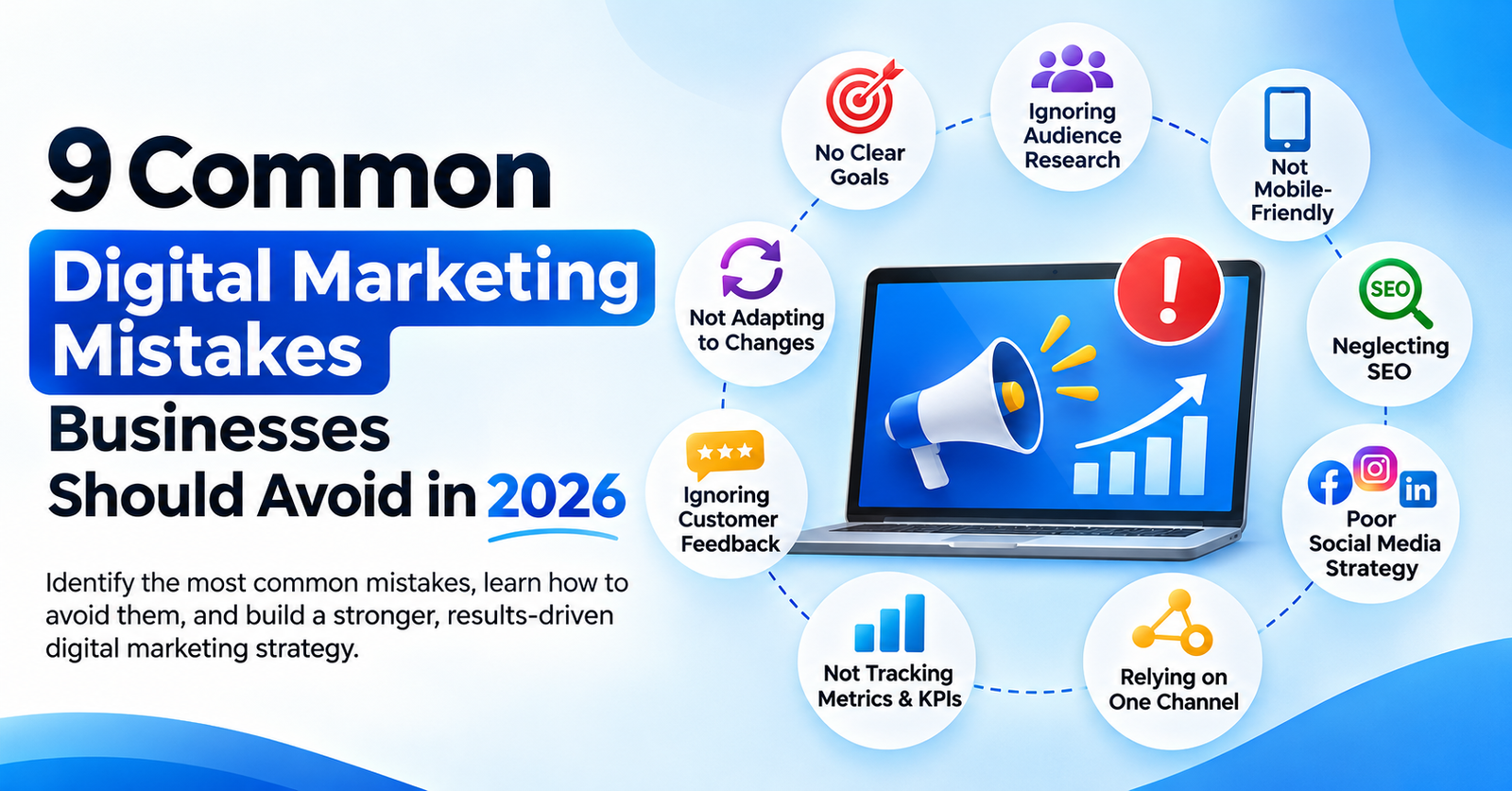
In this guide, we will explore 9 common digital marketing mistakes businesses should avoid in 2026, along with practical solutions to improve your online presence, marketing performance, and return on investment (ROI).
What Are the Most Common Digital Marketing Mistakes?
The most common digital marketing mistakes businesses make include:
- Not setting clear marketing goals and objectives.
- Ignoring target audience research.
- Having a poorly optimized mobile website.
- Neglecting SEO and organic search visibility.
- Using social media without a proper strategy.
- Depending on a single marketing channel.
- Failing to track marketing performance and KPIs.
- Ignoring customer reviews and feedback.
- Not adapting to digital marketing trends and changes.
Let’s understand each mistake and how to avoid it.
1. Not Setting Clear Digital Marketing Goals and Objectives
One of the biggest digital marketing mistakes is starting campaigns without defining clear business objectives. Many businesses invest in Google Ads, Meta Ads, SEO, and social media marketing without understanding what they actually want to achieve.
Without specific goals, it becomes difficult to measure campaign performance, allocate budgets effectively, or determine whether marketing activities are generating business results.
For example, increasing website traffic is not necessarily a successful outcome if visitors are not converting into customers.
How to Avoid This Mistake
Before launching any digital marketing campaign, establish SMART goals:
- Specific: Define exactly what you want to achieve.
- Measurable: Identify metrics to measure success.
- Achievable: Set realistic targets based on your resources.
- Relevant: Align marketing goals with business objectives.
- Time-Bound: Establish a clear deadline.
Example: Instead of setting a goal to increase website traffic, aim to increase organic website traffic by 30% within six months through SEO and content marketing.
Clear objectives help businesses make better marketing decisions and measure actual performance.
2. Ignoring Target Audience Research
Your marketing campaigns can have excellent creatives, attractive offers, and well-written content, but they may still fail if they reach the wrong audience.
Ignoring customer research is a common digital marketing mistake that results in wasted advertising budgets, low engagement, poor conversion rates, and irrelevant website traffic.
Businesses need to understand who their potential customers are, what problems they face, what products they need, and how they make purchasing decisions.
How to Avoid This Mistake
Conduct proper audience research before creating marketing campaigns.
Consider the following factors:
- Demographics: Age, gender, income, education, and location.
- Interests: Hobbies, preferences, and purchasing interests.
- Pain Points: Problems your products or services can solve.
- Online Behaviour: Websites, search engines, and social media platforms they use.
- Buying Behaviour: Purchase frequency, spending habits, and decision-making process.
Use Google Analytics 4, Google Search Console, Meta Audience Insights, customer surveys, and CRM data to understand your audience.
Create detailed buyer personas to develop personalized marketing messages that connect with potential customers.
3. Having a Poorly Optimized Mobile Website
Mobile devices account for a significant share of online browsing and shopping. If your website does not provide a smooth mobile experience, visitors may leave without exploring your products or services.
A slow-loading website, difficult navigation, unreadable content, and complicated checkout process can negatively affect user experience and conversions.
Mobile usability is also important for SEO because Google primarily uses the mobile version of website content for indexing and ranking.
How to Avoid This Mistake
Make mobile optimization an essential part of your website strategy.
Follow these best practices:
- Use a responsive website design.
- Improve website loading speed.
- Compress and optimize images.
- Make navigation simple and user-friendly.
- Use readable fonts and appropriate spacing.
- Ensure buttons and forms work properly on mobile devices.
- Simplify the checkout and payment process.
You can use Google PageSpeed Insights and Google Search Console to identify website performance and mobile usability issues.
A fast, responsive website improves user experience and creates better opportunities for conversions.
4. Neglecting SEO and Organic Search Visibility
Search Engine Optimization (SEO) is one of the most valuable long-term digital marketing strategies. However, many businesses focus entirely on paid advertising and social media while ignoring organic search visibility.
Without an effective SEO strategy, your website may struggle to appear in search results when potential customers search for relevant products, services, or information.
Ignoring SEO can result in missed opportunities to attract high-intent visitors and build sustainable website traffic.
How to Avoid This Mistake
Implement a comprehensive SEO strategy that focuses on three important areas:
On-Page SEO
- Conduct keyword research.
- Optimize title tags and meta descriptions.
- Use relevant keywords naturally throughout your content.
- Create descriptive URLs.
- Improve internal linking.
- Optimize images with descriptive alt text.
- Structure content using relevant headings.
Technical SEO
- Improve website loading speed.
- Fix broken links and crawl errors.
- Submit XML sitemaps.
- Implement appropriate schema markup.
- Ensure mobile responsiveness.
- Use HTTPS security.
- Resolve duplicate content and indexing issues.
Off-Page SEO
- Build relevant, high-quality backlinks.
- Publish guest posts on authoritative websites.
- Develop brand mentions.
- Create shareable and valuable content.
- Strengthen your online reputation.
Businesses should also consider Answer Engine Optimization (AEO) and Generative Engine Optimization (GEO) by publishing clear, authoritative, well-structured content that helps search engines and AI-powered platforms understand their expertise.
Consistent SEO efforts can help improve organic visibility, attract relevant traffic, and support long-term business growth.
5. Using Social Media Without a Proper Strategy
Creating social media accounts and posting occasionally is not enough to build a strong online presence.
Many businesses make the mistake of treating social media as a platform for simply publishing promotional content. They overlook audience engagement, content quality, consistency, and performance analysis.
As a result, their posts receive limited engagement and fail to generate meaningful business opportunities.
How to Avoid This Mistake
Develop a social media marketing strategy based on your business objectives and audience preferences.
Follow these practices:
- Choose platforms that your target audience actively uses.
- Create a monthly social media content calendar.
- Publish educational, entertaining, and promotional content.
- Use engaging images, videos, reels, and carousel posts.
- Respond to comments and direct messages.
- Use relevant hashtags and keywords naturally.
- Track engagement, reach, clicks, and conversions.
For example, an eCommerce fashion brand may benefit from Instagram, Pinterest, and Facebook marketing, while a B2B company may achieve better results through LinkedIn.
Focus on building meaningful relationships rather than simply increasing follower counts.
6. Depending on Only One Digital Marketing Channel
Relying on a single marketing channel can create unnecessary risks for businesses.
For example, a company that depends entirely on Facebook Ads may experience difficulties when advertising costs increase, campaign performance declines, or platform policies change.
Similarly, businesses relying only on organic SEO may struggle when search algorithms or competitive conditions change.
A successful digital marketing strategy should combine multiple channels to reach potential customers at different stages of their buying journey.
How to Avoid This Mistake
Build a balanced digital marketing strategy using a combination of channels:
| Marketing Channel | Primary Purpose |
|---|---|
| SEO | Generate long-term organic traffic |
| Google Ads | Reach customers with high purchase intent |
| Meta Ads | Build awareness, generate leads, and drive sales |
| Social Media Marketing | Build brand awareness and engagement |
| Email Marketing | Improve customer retention and repeat purchases |
| Content Marketing | Educate audiences and establish authority |
| Pinterest Marketing | Drive discovery and referral traffic |
You do not need to use every channel simultaneously. Start with the platforms that align with your business model, audience, and budget.
Analyze the results and gradually expand your marketing efforts into other relevant channels.
7. Not Tracking Marketing Metrics and KPIs
Running digital marketing campaigns without tracking their performance is like running a business without understanding its results.
Many businesses focus on vanity metrics such as impressions, likes, and followers while ignoring more important indicators such as leads, sales, customer acquisition costs, and return on advertising spend.
Without accurate tracking, businesses cannot identify which campaigns are performing well or where their marketing budget is being wasted.
How to Avoid This Mistake
Define relevant Key Performance Indicators (KPIs) for every marketing channel.
Important digital marketing metrics include:
- Website Traffic: Number of visitors coming to your website.
- Conversion Rate: Percentage of visitors completing a desired action.
- Cost Per Lead (CPL): Average cost of generating one lead.
- Customer Acquisition Cost (CAC): Cost of acquiring a new customer.
- Return on Ad Spend (ROAS): Revenue generated for every unit of advertising spend.
- Click-Through Rate (CTR): Percentage of users clicking an advertisement or link.
- Engagement Rate: Level of audience interaction with your content.
- Organic Rankings: Search visibility for targeted keywords.
Use tools such as Google Analytics 4, Google Search Console, Google Ads, Meta Ads Manager, and appropriate CRM platforms to monitor your performance.
Review campaign data regularly and make decisions based on measurable results rather than assumptions.
8. Ignoring Customer Reviews and Feedback
Customer feedback plays an important role in building brand credibility and improving customer relationships.
Many businesses focus on acquiring new customers but fail to listen to existing customers. Ignoring negative reviews, unanswered questions, and customer complaints can damage brand reputation and reduce customer trust.
Positive customer experiences, on the other hand, can encourage repeat purchases, recommendations, and stronger brand loyalty.
How to Avoid This Mistake
Make customer feedback an important part of your digital marketing strategy.
Here are some practical steps:
- Monitor reviews on Google Business Profile and relevant review platforms.
- Respond professionally to positive and negative reviews.
- Encourage satisfied customers to share genuine experiences.
- Monitor social media comments and messages.
- Conduct customer satisfaction surveys.
- Use customer feedback to improve products and services.
For local businesses, maintaining an updated Google Business Profile and responding to customer reviews can also strengthen local search visibility and customer confidence.
Remember, customer feedback is not just about reputation management. It is an opportunity to understand your audience and improve your overall business experience.
9. Not Adapting to Digital Marketing Trends and Technology
Digital marketing continues to evolve as search engines, advertising platforms, consumer behaviour, and technology change.
Strategies that worked a few years ago may not deliver the same results today. Businesses that fail to adapt may lose visibility, miss new opportunities, and fall behind competitors.
In 2026, marketers need to understand developments in AI-powered search, automation, personalized advertising, short-form video, privacy regulations, and changing search experiences.
How to Avoid This Mistake
Stay informed about industry developments and continuously improve your marketing strategies.
Focus on these important areas:
- AI in Digital Marketing: Use AI tools to support content research, data analysis, campaign planning, and marketing automation.
- Answer Engine Optimization (AEO): Structure content to answer specific user questions clearly.
- Generative Engine Optimization (GEO): Create reliable, informative content that AI-powered search platforms can understand and reference.
- Voice and Conversational Search: Address natural-language search queries through useful question-based content.
- Marketing Automation: Automate repetitive activities such as email follow-ups and lead nurturing.
- Personalization: Deliver relevant experiences based on customer preferences and behaviour.
- Performance Marketing: Continuously test campaigns, creatives, audiences, and landing pages.
Follow trusted industry publications, attend webinars, experiment with new tools, and regularly review your marketing performance.
Businesses that adapt their strategies based on changing customer expectations and technology can build stronger competitive advantages.
How Can Businesses Build a Successful Digital Marketing Strategy in 2026?
Avoiding common marketing mistakes is only the first step. Businesses also need a clear strategy that connects their marketing activities with measurable business outcomes.
Follow this simple framework:
| Step | What to Do | Expected Outcome |
|---|---|---|
| 1 | Define business and marketing goals | Clear direction |
| 2 | Research your target audience | Better targeting |
| 3 | Optimize your website | Improved user experience |
| 4 | Implement SEO and content marketing | Organic visibility |
| 5 | Launch relevant paid campaigns | Targeted traffic and leads |
| 6 | Build social media engagement | Brand awareness |
| 7 | Set up analytics and conversion tracking | Measurable performance |
| 8 | Test and optimize campaigns | Improved marketing efficiency |
The key is to continuously analyze, test, and improve your marketing activities instead of relying on assumptions.
Frequently Asked Questions (FAQs)
1. What are the biggest digital marketing mistakes businesses make?
The biggest digital marketing mistakes include not setting clear goals, ignoring audience research, neglecting SEO, having a poor mobile website, using social media without a strategy, relying on one marketing channel, and failing to track campaign performance.
2. Why do digital marketing campaigns fail?
Digital marketing campaigns often fail because of poor audience targeting, unclear objectives, weak creatives, ineffective landing pages, incorrect budget allocation, and a lack of conversion tracking. Businesses should regularly analyze campaign data and optimize their strategies to improve results.
3. How can small businesses avoid digital marketing mistakes?
Small businesses can avoid digital marketing mistakes by defining realistic goals, understanding their target audience, building a user-friendly website, implementing SEO, choosing suitable marketing channels, and tracking important KPIs.
4. Why is SEO important for digital marketing?
SEO helps businesses improve their visibility in organic search results, attract relevant website visitors, build online credibility, and generate long-term traffic. It also supports content discovery through traditional and AI-powered search experiences.
5. Which digital marketing channels are best for business growth?
The most suitable channels depend on your business type, audience, and objectives. SEO, Google Ads, Meta Ads, email marketing, social media marketing, and content marketing are commonly used to increase visibility, generate leads, and drive sales.
6. What digital marketing trends should businesses follow in 2026?
Important digital marketing developments in 2026 include AI-powered marketing, AEO, GEO, personalized customer experiences, marketing automation, video content, privacy-focused advertising, and data-driven performance optimization.
7. How often should businesses review their digital marketing strategy?
Businesses should monitor campaign performance regularly, review key metrics at least monthly, and conduct more detailed strategic evaluations quarterly. Paid advertising campaigns may require more frequent optimization depending on their budget and performance.
Conclusion: Avoid Digital Marketing Mistakes and Build a Stronger Online Presence
Digital marketing success is not just about running advertisements, publishing social media posts, or optimizing website content. It requires a well-planned strategy, a clear understanding of your target audience, consistent execution, and continuous performance analysis.
By avoiding these nine common digital marketing mistakes, businesses can improve their online visibility, attract relevant customers, generate quality leads, and achieve sustainable growth.
Remember that successful digital marketing is an ongoing process. Set measurable goals, invest in the right channels, understand your customers, track important metrics, and adapt your strategies as the industry evolves.
Looking to improve your digital marketing performance? Start by identifying the areas where your current strategy needs improvement and take practical steps toward building a stronger digital presence.