|
Getting your Trinity Audio player ready... |
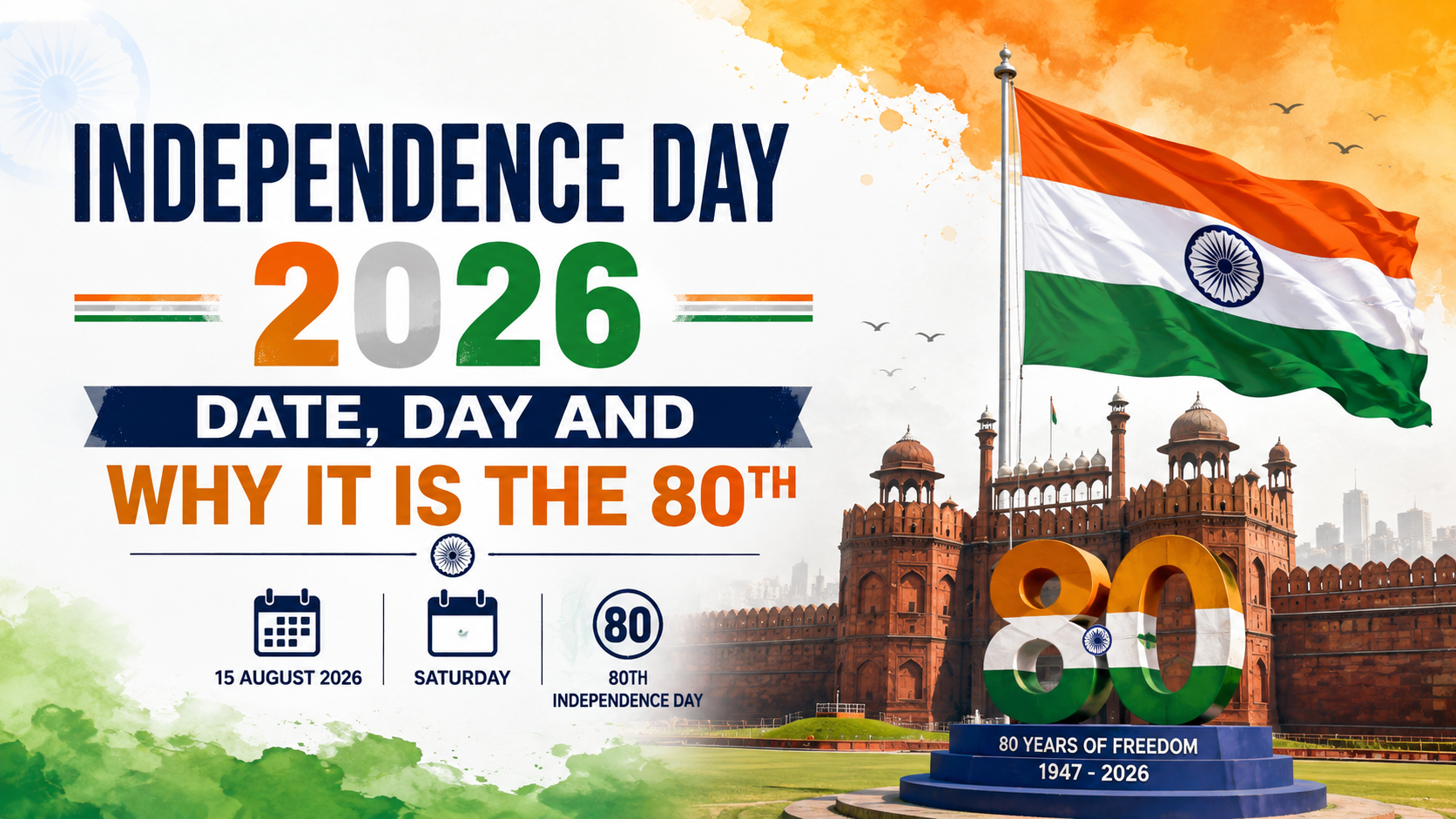
Independence Day 2026 falls on Saturday, 15 August 2026. It is India’s 80th Independence Day, and it marks 79 completed years since the country became free in 1947.
If those last two numbers look like they contradict each other, you are not alone this is the single most searched confusion about the day, and it comes up in school quizzes, speeches and newspaper headlines every August. Both are right, and the reason is simple once you see it.
Quick answers
- Date: 15 August 2026
- Day of the week: Saturday
- Which Independence Day: the 80th
- Years of independence completed: 79
- Year India became free: 1947
- Where the national flag is hoisted: the Red Fort, Delhi, by the Prime Minister
Is 15 August 2026 a Saturday?
Yes. 15 August 2026 is a Saturday.
For most schools and colleges that does not move the celebration the flag hoisting, the march past and the cultural programme are held on 15 August itself, Saturday or not, because the date is the point. Many offices that would normally be closed on a Saturday still hold a short flag ceremony in the morning.
It does mean that in 2026 the holiday does not create an extra day off for most salaried workers, since Independence Day is a gazetted holiday falling on a day many people already have free.
Is it the 79th or the 80th Independence Day?
It is the 80th Independence Day. The confusion comes from mixing up two different things that people use the same word for:
- Years completed — how much time has passed since 1947. In 2026 that is 79 years.
- Which celebration it is — how many Independence Days India has had, counting the first one. That is 80.
The reason the second number is one higher is that 15 August 1947 was itself the 1st Independence Day. On that day zero years had passed, but the country was still celebrating. So the count runs: 1947 was the 1st, 1948 was the 2nd, and so on.
The arithmetic is: year − 1947 + 1. For 2026 that is 2026 − 1947 + 1 = 80.
You can check the formula against a year you already know. In 2023 the celebration was widely reported as the 77th Independence Day: 2023 − 1947 + 1 = 77. It works.
So both of these sentences are correct, and you can safely use either in a speech:
- “Today we celebrate our 80th Independence Day.”
- “Today we complete 79 years of freedom.”
What you should not write is “79th Independence Day” or “80 years of independence” those are the two ways to get it wrong, and they are the versions that most often slip into school speeches.
How many years of independence in 2026?
79 years. India became independent on 15 August 1947, so on 15 August 2026 the country completes 79 full years of freedom and begins its 80th year.
That last phrase is worth noting too: on 15 August 2026 India enters its 80th year of independence, having completed 79. It is the same logic as a person turning 79 they have completed 79 years and are living through their 80th.
Independence Day: day and number by year
| Year | Day of the week | Which Independence Day | Years completed |
|---|---|---|---|
| 2024 | Thursday | 78th | 77 |
| 2025 | Friday | 79th | 78 |
| 2026 | Saturday | 80th | 79 |
| 2027 | Sunday | 81st | 80 |
| 2028 | Tuesday | 82nd | 81 |
| 2029 | Wednesday | 83rd | 82 |
| 2030 | Thursday | 84th | 83 |
The day of the week normally moves forward by one each year and by two across a leap year — which is why 2027 is a Sunday but 2028 jumps to Tuesday, skipping Monday.
Hoisting or unfurling? Independence Day vs Republic Day
This is the other detail that quiz masters love, and it is genuinely useful to get right if you are speaking on stage.
- Independence Day (15 August): the flag is hoisted. It is tied at the bottom of the pole and pulled up, then opened. This recalls 1947, when a new nation raised its flag for the first time. The Prime Minister does this at the Red Fort in Delhi and then addresses the country.
- Republic Day (26 January): the flag is unfurled. It is already tied at the top of the pole and is simply opened out, because by then the nation and its flag already existed. The President does this in Delhi.
The reason the President leads on Republic Day and the Prime Minister on Independence Day is that the President is the constitutional head of state, and Republic Day marks the day the Constitution came into effect 26 January 1950. In 2026, Republic Day was the 77th, and it fell on a Monday.
What happens on 15 August
The national ceremony is at the Red Fort in Delhi: the Prime Minister hoists the tricolour, a 21-gun salute is fired, the national anthem is sung, and the Prime Minister delivers an address to the nation. State capitals hold their own ceremonies led by the Chief Minister or Governor.
In schools the shape of the morning is fairly standard across the country flag hoisting, the national anthem, speeches by students and the principal, patriotic songs and dances, sometimes a march past, and sweets before everyone goes home.
If you have been asked to speak at one of these, the good news is that expectations are clear and kind. Nobody is looking for grand vocabulary. They are looking for someone who sounds like they mean it.