|
Getting your Trinity Audio player ready...
|
If you are running a business online, you eventually hit the same roadblock every marketer faces: How do I get people to my website?
You know you need traffic. You know you need customers. But when you look at the options, it usually boils down to two heavyweights: Search Engine Optimization (SEO) and Pay-Per-Click (PPC) advertising.
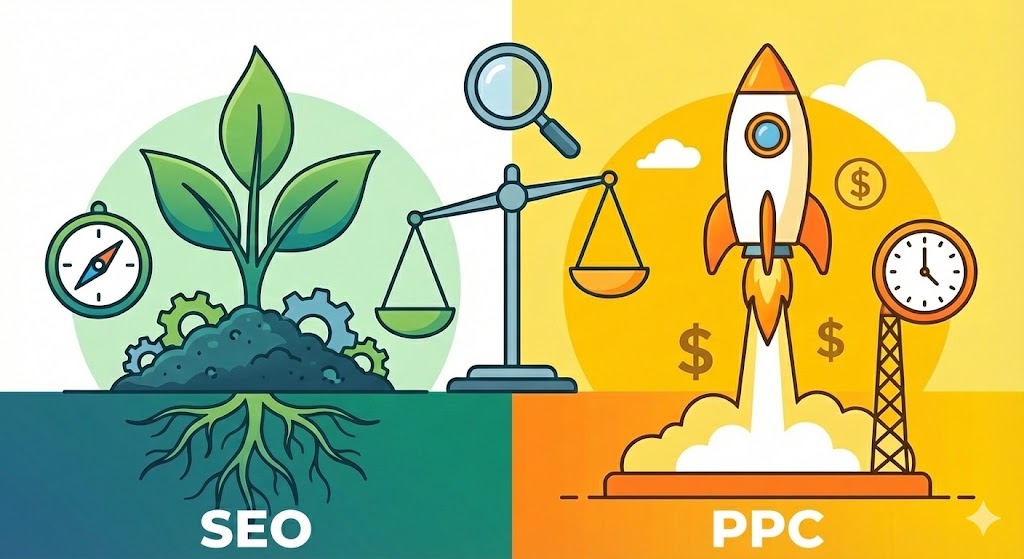
It’s the classic “time versus money” debate. One requires patience and sweat equity; the other requires a budget and a strategy. So, which one is right for you? The honest answer is that it depends entirely on where your business stands right now and where you want it to be in six months.
In this guide, we are going to break down the real differences between SEO and PPC, look at the pros and cons of each, and help you decide which path or combination of paths will give you the best return.

The Long Game: Understanding SEO
Think of SEO (Search Engine Optimization) like buying a house. It takes a long time to save up for the deposit, fill out the paperwork, and move in. But once you do, you own the asset. Over time, that house builds equity.
SEO is the process of improving your website so that Google (and other search engines) see it as a valuable resource. When you prove you are valuable, Google ranks you higher.
Why Businesses Choose SEO
- It’s “Free” Traffic: technically, you aren’t paying Google for these clicks. Once you rank for a keyword, that traffic comes to you 24/7 without a direct cost per visitor.
- Trust and Credibility: Users are smart. They know which results are ads and which are organic. Many users skip the ads entirely and click the first organic result because they trust that Google chose it for a reason.
- Compounding Returns: A good piece of content you write today can drive traffic for years. Unlike ads, which stop working the second you stop paying, SEO builds momentum.
- Better ROI Over Time: While SEO is expensive at the start (hiring writers, technical fixes), the cost per lead drops significantly over time as your traffic grows without your costs increasing.
The Downside of SEO
The biggest hurdle is time. You cannot force Google to rank you tomorrow. It can take 3, 6, or even 12 months to see significant movement. It requires consistency, patience, and the ability to adapt when Google updates its algorithm.

The Fast Lane: Understanding PPC
If SEO is buying a house, PPC (Pay-Per-Click) is renting a luxury apartment. You can move in this afternoon if you have the cash. But the moment you stop paying rent, you’re out on the street.
PPC platforms like Google Ads, Facebook Ads, or LinkedIn Ads allow you to bid for placement. You create an ad, select who you want to see it, and pay a fee every time someone clicks on it.
Why Businesses Choose PPC
- Speed: This is the biggest advantage. You can launch a campaign in the morning and have your first sale by the afternoon. If you have a time-sensitive offer, PPC is the only way to go.
- Precision Targeting: SEO casts a wide net, but PPC is a sniper rifle. You can target people based on their specific location, age, income, interests, and even what they are currently searching for.
- Total Control: You control the budget down to the penny. If an ad isn’t working, you turn it off. If it is working, you double the budget. You have full control over the message and the landing page.
- Dominating the Top Spot: On mobile devices especially, ads take up the entire screen. Even if you rank #1 organically, a competitor with a PPC ad will still appear above you.
The Downside of PPC
It can get expensive quickly. In competitive industries (like insurance or law), a single click can cost upwards of $50. Plus, unlike SEO, there is no equity. When your budget runs out, the traffic stops immediately.
The Showdown: How to Choose
If you are stuck trying to decide, look at these four specific factors in your business:
1. Your Budget
- Shoestring Budget: If you have more time than money, start with SEO. Focus on creating great content and fixing your site.
- Marketing Budget Available: If you have funds set aside for growth, PPC is a safer bet to validate your product and get cash flow moving quickly.
2. Your Timeline
- Need sales yesterday? Choose PPC. It is the only channel that delivers instant demand.
- Planning for next year? Start SEO now. Future-you will be thankful for the organic traffic foundation.
3. Your Authority
- New Brand: If nobody knows who you are, it is hard to rank organically. PPC can help get your name out there while you build your SEO reputation.
- Established Brand: If you already have domain authority, doubling down on SEO usually yields better margins.
4. Commercial Intent
- Transactional Searches: If people are searching “Buy leather running shoes,” they are ready to buy. PPC is great for this because you can capture that intent immediately.
- Informational Searches: If people are searching “how to clean running shoes,” they are just looking for info. SEO is better here; you don’t want to pay for clicks from people who are just browsing.

The Smart Move: The Hybrid Strategy
The truth is, you shouldn’t really view this as “SEO vs. PPC.” The most successful companies use them together. They are not enemies; they are partners.
Here is how a hybrid approach works:
- Test with PPC: Not sure which keywords convert? Run a small PPC campaign. If “blue running shoes” gets you sales, then you know it’s worth spending 6 months trying to rank for it with SEO.
- Retargeting: Use SEO to get people to your blog for free. Then, use PPC to show “retargeting” ads to those specific visitors to bring them back to buy.
- Dominate the Page: If you rank #1 organically and have an ad at the top, you dominate the search results. This increases the likelihood that a user clicks on your brand rather than a competitor.
Final Verdict
So, which one wins?
- Choose PPC if you have a new product, a time-sensitive event, or need immediate cash flow and have the budget to support it.
- Choose SEO if you want to build a sustainable brand, lower your acquisition costs over time, and aren’t in a rush for immediate spikes in traffic.
Ultimately, digital marketing isn’t about picking one lane and staying there. It’s about balancing your immediate needs with your long-term goals. Start where your budget allows, but keep your eyes on the horizon.